
The importance of understanding True Odds
by Bill Burton
The following article is graciously provided by Bill Burton, the Casino GamblingExpert and Guide at About.com.True Odds are the real probability of rolling a specific combination. The casinogenerally pays you less than true odds, which is how they make a profit. But theFree Odds bets are paid at the actual true odds and thereforecarry no house edge — which is why you should put most of your craps money on theFree Odds bets.
In this article Bill Burton explains what True Odds are.
Understanding Dice Odds
Last time I discussed the basics of playing craps. In order to play the game youobviously need dice. You also need an understanding of the dice and the odds andprobabilities of rolling the numbers.
In the movies you will see the players picking up the dice and rolling them togetherin both hands before letting them fly down the table as they scream, “Baby needsa new pair of shoes!” or some other wild chant. This is fine in the movies but ina real casino you are only allowed to handle the dice with one hand. Dice are actuallyprecision instruments manufactured to very strict specifications. They are inspectedfor any flaws such as nicks or chips before being put in to play. Rubbing them togetheror other rough handling can damage dice. If the dice are thrown off the table theyhave to be checked before being put back into play. The average life of a pair ofdice is only about eight hours, and then the casino replaces them to ensure thatthe game dice are fresh and fair.
Let’s take a look the dice. They’re cubes, about three quarters of an inch square.One alone is called a die. Each die has spots called “pips” totaling a number fromone to six on each side. If you add the corresponding sides you will get the numberseven. The side with six pips will have one pip on the opposite side. Two and fiveare on corresponding sides as are the three and four. Since each die has six sidesand the game is played with two dice, there are 36 (6 x 6) combinations that canbe made giving totals of two through twelve.
Take a look at the Dice Chart:
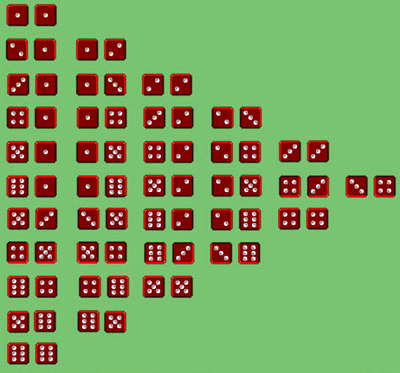
You will see that there is only one way to make the numbers two (1 and 1) and twelve(6 and 6). There are two ways to make the number three: (2 and 1) and (1 and 2).If it helps you to understand the combinations, picture a blue and a red die. Youcould have number one on the red and two on the blue, or number two on the red andnumber one on the blue.
There are two ways to make the three and eleven.
There are three ways to make the four and ten.
There are four ways to make the five and nine.
There are five ways to make the six and eight.
There are six ways to make the seven.
By knowing how the numbers are made, you can calculate the odds of making any numberbefore the seven is rolled. Since the number 7 can be rolled six ways, you dividethe number six by the number of ways a number is rolled.
| Number | # ways to roll | True Odds |
| 4 | 3 | 2 to 1 |
| 5 | 4 | 3 to 2 |
| 6 or 8 | 5 | 6 to 5 |
| 9 | 4 | 3 to 2 |
| 10 | 3 | 2 to 1 |
Once you understand the odds and probabilities of the dice, you are on your wayto mastering the game of craps.
Until next time, remember: “Luck comes and goes…Knowledge staysforever.”